The world of architecture is often celebrated for its triumphs the soaring towers, the elegant museums, the bridges that defy gravity. These structures become symbols of human ingenuity, economic power, and cultural identity. However, for every celebrated masterpiece, there exists a shadow history of projects plagued by catastrophic failure. These are not mere construction delays or budget overruns; these are profound systemic breakdowns where ambition outstrips execution, ethics are compromised, and the very principles of safety and functionality are ignored. The resulting scandals erode public trust, cause immense financial ruin, and sometimes, tragically, cost human lives. This deep dive explores the intricate anatomy of architectural failure, moving beyond the headlines to understand the complex interplay of flawed design, engineering negligence, corrupt governance, and unbridled hubris that leads to some of the world’s most infamous building disasters.
A. The Anatomy of a Catastrophe: Core Reasons Behind Architectural Failures
Architectural failures are seldom the result of a single error. They are typically the culmination of a perfect storm of interconnected failures across multiple stages of a project’s lifecycle.
A. The Arrogance of Over-Innovation: Pushing the boundaries of design and engineering is essential for progress. However, when innovation is pursued without rigorous peer review, exhaustive testing, and a deep respect for known physical laws, disaster looms. This often involves using novel materials or structural systems in untested ways, combined with a “it can’t fail” mentality that silences dissent.
B. The Corruption Quotient: From bribery in the bidding process to the use of substandard materials to maximize illicit profits, corruption is a cancer that compromises structural integrity at its core. It leads to the bypassing of safety inspections, the certification of unqualified contractors, and a complete breakdown of regulatory oversight.
C. The Value Engineering Trap: Initially a process of optimizing cost versus function, value engineering often devolves into reckless cost-cutting. Critical structural elements, high-quality materials, and essential safety features are stripped away to meet arbitrary budgets, leaving a building fundamentally weakened.
D. Communicative Collapse: Architecture is a collaborative endeavor. When architects, structural engineers, mechanical engineers, and contractors operate in silos, with poor documentation and change-order management, critical details fall through the cracks. A change in the façade by the architect may not be communicated to the engineer calculating the load, with fatal consequences.
E. Regulatory Capture and Lax Enforcement: Sometimes, powerful developers or political figures exert undue influence on building authorities, leading to the watering-down of codes or the expedited approval of demonstrably flawed plans. The regulatory body, meant to protect the public, becomes a rubber stamp.
B. Case Studies in Catastrophe: Deconstructing Famous Failures
To understand these principles in action, we must examine the case studies that have become textbook examples of what not to do.
1. The Fatal Flaws of the Sampoong Department Store (South Korea, 1995)
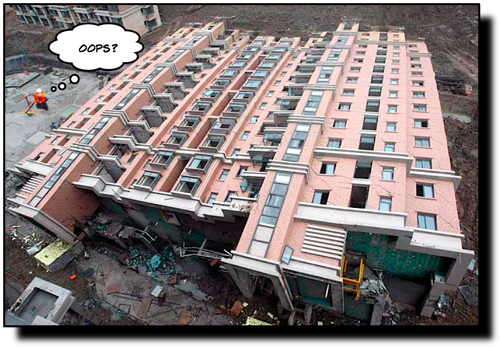
This tragedy is a masterclass in greed, corruption, and willful negligence. The Sampoong Group’s chairman, Lee Joon, drastically altered the building’s design mid-construction, changing its use from an office building to a department store. This required removing crucial support columns to install escalators. Engineers warned of the danger, but were fired and replaced. Further criminal modifications included adding a heavy fifth-floor restaurant (a change from the planned roller-skating rink) and installing a massive air-conditioning unit on the already-overloaded roof. On June 29, 1995, the fifth-floor ceiling showed critical cracks. Managers, concerned about lost revenue, did not evacuate. Hours later, the entire structure pancaked, killing 502 people. The scandal exposed a culture of profit over all else, including human life, and led to significant reforms in South Korea’s building safety laws.
2. The Leaning Tower of… San Francisco? (Millennium Tower)
San Francisco’s Millennium Tower is a slow-motion scandal of sinking and tilting. The 58-story luxury condominium, built on soft bay mud and landfill, was constructed with a foundation of friction piles concrete pillars driven into the sand that hold the building up through surface friction, rather than resting on bedrock. This was a cost-saving decision. Compounding the error, the adjacent construction of the Salesforce Transit Center pumped out groundwater, causing the soil to compact. The tower has sunk over 18 inches and tilted at least 14 inches at the tip. The scandal involves relentless litigation between the developer, the Transbay Joint Powers Authority, and hundreds of angry residents owning multi-million-dollar apartments now worth a fraction of their value. It is an ongoing, costly lesson in geotechnical engineering and the perils of unsuitable foundations for mega-structures.
3. The Combustible Cladding Crisis: Grenfell Tower (London, 2017)
The Grenfell Tower fire is perhaps the most harrowing example of regulatory failure and value engineering gone murderously wrong. The 24-story social housing block underwent a refurbishment aimed at improving energy efficiency and aesthetics. As part of this, new external cladding, rainscreen panels, and windows were installed. The cladding core was made of polyethylene (a highly flammable plastic), not a more fire-resistant material, saving approximately £2 per square meter. The refurbishment turned the tower into a virtual chimney. When a small kitchen fire broke out on June 14, 2017, it shot up the exterior, engulfing the entire building in minutes, claiming 72 lives. The scandal revealed a labyrinth of blame: the manufacturer marketing dangerous products, contractors installing them, inspectors failing to recognize the risk, and a government that had ignored years of warnings about combustible cladding. It sparked a global reckoning on building safety standards.
4. The Dysfunctional Destiny of the Sydney Opera House
While now an iconic success, the Sydney Opera House’s construction was initially a legendary scandal of technical failure in cost and scheduling. Architect Jørn Utzon’s breathtaking, expressionist shell designs were conceived without a clear engineering plan to build them. The original budget was AUS $7 million. The final cost? AUS $102 million, funded by a state lottery. The project, slated for four years, took fourteen. The radical shell geometry posed an impossible construction challenge for years until an engineering team discovered the solution: crafting all the shells from sections of a single imaginary sphere. This allowed for prefabrication. Utzon resigned midway in 1966 amid a bitter political feud over costs and delays. The project stands as a dual symbol: of the devastating cost of under-scoped visionary design, but also of the ultimate triumph of perseverance and engineering ingenuity over near-impossible odds.
5. The Big Dig’s Ceiling Collapse (Boston, 2006)
Boston’s Big Dig, officially the Central Artery/Tunnel Project, was the most complex and expensive highway project in U.S. history. While largely an engineering success, it was marred by a fatal scandal. In 2006, a section of the ceiling in the I-90 connector tunnel, weighing several tons, collapsed onto a car, killing a passenger. The investigation revealed a catastrophic failure in the epoxy adhesive system used to secure the ceiling anchor bolts. The wrong epoxy a formulation that creeps (slowly deforms) under sustained load was used. Furthermore, the installation was poorly supervised. The scandal led to a massive legal settlement, criminal charges for a materials company, and a lasting legacy of public anxiety about infrastructure safety. It underscored that even in mega-projects, the failure of a single, seemingly minor component can be catastrophic.
C. The Ripple Effects: Consequences Beyond Collapse
The impact of these scandals extends far beyond the immediate damage.
A. Legal and Financial Avalanches: The ensuing lawsuits can last for decades, involving billions in damages, insurance claims, and criminal prosecutions. Reputational ruin for the firms involved is often permanent.
B. Erosion of Public Trust: Citizens lose faith in the safety of their built environment, in the competency of developers, and in the government’s ability to regulate and protect them.
C. Paradigm Shifts in Regulation and Practice: Major failures often force a wholesale rewriting of building codes (e.g., post-Grenfell cladding bans, post-Sampoong stricter inspection regimes). They also spur new engineering standards and professional ethics requirements.
D. The Human and Social Toll: The loss of life is the most profound tragedy. Survivors and communities are left with lasting trauma. Social housing disasters like Grenfell also starkly highlight issues of social inequality and neglect.
D. Building a Safer Future: Lessons Learned and Paths Forward
To prevent future scandals, the industry must institutionalize the hard lessons from the past.
A. Embrace Radical Transparency: All project documentation, material specifications, and change orders should be recorded on immutable, shared digital platforms accessible to all stakeholders and, where appropriate, the public.
B. Strengthen Whistleblower Protections: Individuals who raise safety concerns must be protected from retaliation, not fired as in the Sampoong case.
C. Enforce Unbreakable Chain of Custody for Materials: From factory to installation, every building component should be traceable, with batch testing to prevent substandard or fraudulent materials from entering the supply chain.
D. Implement Lifecycle Accountability: Architects and engineers should have a mandated, ongoing role in monitoring the health of their super-complex structures for a defined period post-construction.
E. Cultivate a Culture of Humility: The architectural and engineering community must replace hubris with a culture of peer review, redundancy, and a fundamental acceptance that “failure is an option” that must be designed against.
Conclusion
The spectacles of architectural failure the leaning towers, the burnt husks, the pancaked slabs are not merely tales of concrete and steel gone wrong. They are profound human dramas that expose the vulnerabilities in our systems of creation and governance. They remind us that the built environment is a covenant between society and its stewards: developers, architects, engineers, and officials. When that covenant is broken for vanity, greed, or negligence, the results are devastating. By studying these scandals with unflinching honesty, the industry can move from a pattern of reactive disaster response to a proactive ethic of unwavering safety, integrity, and respect for the human lives its work is meant to shelter and inspire. The goal is not to stifle innovation, but to ensure that the march toward the sky is built upon the unshakable foundation of responsibility.